You're shopping: DAVIDSONVILLE
(change store)
Departments - LONICERA 'PEACHES & CREAM' 3G
LONICERA 'PEACHES & CREAM' 3G
no reviews for this product. Login to place a review.
Your Price $39.99
Item Number 383768
In store quantity:
6
Peaches And Cream Honeysuckle
Lonicera periclymenum 'Peaches And Cream'
Height: 20 feet
Spread: 24 inches
Sunlight: Full sun / Partial shade
Hardiness Zone: 4b
Other Names: Woodbine Honeysuckle
Description:
An impressive fast-growing twining vine covered in bicolor pink and white flowers, followed by a profusion of bright red berries. It is well suited for covering eaves, arbors, walls, and fences and is an excellent choice for attracting birds.
Ornamental Features:
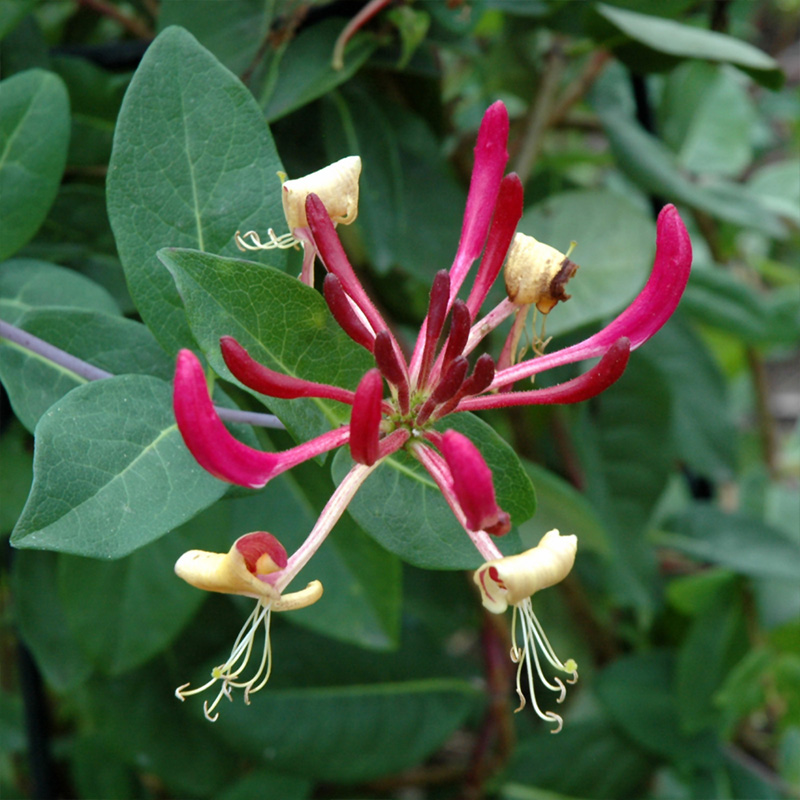
Peaches And Cream Honeysuckle features showy clusters of fragrant shell pink trumpet-shaped flowers with rose overtones from late spring to mid summer. It produces abundant bright red berries from mid to late summer. It has green deciduous foliage, and the oval leaves do not develop notable fall color.
Landscape Attributes:
Peaches And Cream Honeysuckle is a multi-stemmed deciduous woody vine with a twining and trailing growth habit. Its average texture blends into the landscape but can be balanced by one or two finer or coarser plants for an effective composition.
This woody vine requires occasional maintenance and is best pruned in late winter once the threat of extreme cold has passed. It is a good choice for attracting butterflies and hummingbirds and has no significant negative characteristics.
Peaches And Cream Honeysuckle is recommended for the following landscape applications:
- Mass Planting
- Hedges and Screening
- General Garden Use
- Groundcover
Planting & Growing:
Peaches And Cream Honeysuckle will grow to be about 20 feet tall at maturity, with a spread of 24 inches. As a climbing vine, it tends to be leggy near the base and benefits from underplanting with low-growing facer plants. It should be planted near a fence, trellis, or other structure where it can be trained to grow upward, or allowed to trail over a retaining wall or slope. It grows at a medium rate and under ideal conditions can be expected to live for approximately 20 years.
This vine performs best in full sun to partial shade and prefers average to evenly moist soil but will not tolerate standing water. It is not particular about soil type or pH and is somewhat tolerant of urban pollution. Applying a thick mulch around the root zone in winter helps protect it in exposed locations or colder microclimates. This is a selection of a native North American species.